
Everyday Consumers
People who regularly use credit cards and debit cards for shopping, bills, subscriptions, travel, and daily expenses.
MFSS is being developed around a focused vision: creating a stronger protective boundary between unauthorized users and the credit and debit cards consumers depend on every day.
Credit card security • Debit card security • Unauthorized use protection

An estimated 215 million to 223 million U.S. adults hold at least one credit card in 2026.
An estimated 220 million to 230 million U.S. adults hold at least one debit card, with approximately 80% of the adult population actively utilizing them for everyday purchases.
of U.S. adults had at least one credit card in 2025
Source: Federal Reserve, Economic Well-Being of U.S. Households in 2025
consumer payments were made using credit or debit cards
Source: Federal Reserve Financial Services, 2026 Diary of Consumer Payment Choice
of U.S. adults reported experiencing credit-card fraud during 2025
Source: Federal Reserve, Economic Well-Being of U.S. Households in 2025
in reported U.S. consumer fraud losses during 2025
Includes all fraud categories, not credit-card fraud alone.
Source: Federal Trade Commission, Consumer Sentinel data for 2025
Statistics provide general national context and do not represent MFSS customer results, service performance, prevented losses, or guaranteed outcomes.
Credit and debit cards are part of everyday life, but unauthorized use, compromised information, skimming, account takeover, and other forms of card fraud continue to affect consumers across the country.
MFSS was created around a focused idea: develop a stronger layer of protection between consumers, their cards, and unauthorized activity while preserving normal access to everyday financial use.
That idea became the foundation for Maximum Financial Security Services.
Credit cards and debit cards support daily purchases, bills, subscriptions, travel, and online activity.
Credit cards and debit cards together represent two-thirds of U.S. consumer payments.
The Federal Reserve reported that 16% of adults experienced credit-card fraud in 2025.
Security-focused services being developed to help consumers strengthen the protection surrounding everyday credit card use.
Consumer-focused services designed around the debit cards people use for daily purchases, bill payments, and access to personal funds.
A specialized focus on risks involving unlawful or unauthorized card activity and the steps consumers may take to improve their card security.
Clear, responsible information intended to help cardholders better understand security concerns and respond with greater confidence.
Understanding the general methods associated with card fraud helps consumers recognize where their information is most exposed.
Compromised payment information may be used during online or remote transactions without possession of the physical card.
Fraudulent devices may be used at payment terminals or ATMs to capture card information.
Phishing, compromised passwords, social engineering, malware, or stolen credentials may be used to access an account.
Exposed records may contain card numbers, expiration dates, security codes, cardholder names, and billing addresses.
Criminal operations may combine phishing, impersonation, artificial intelligence, deepfakes, credential compromise, account takeover, and synthetic identities.
General educational information only. MFSS does not represent that any service prevents, detects, or eliminates every form of card fraud.
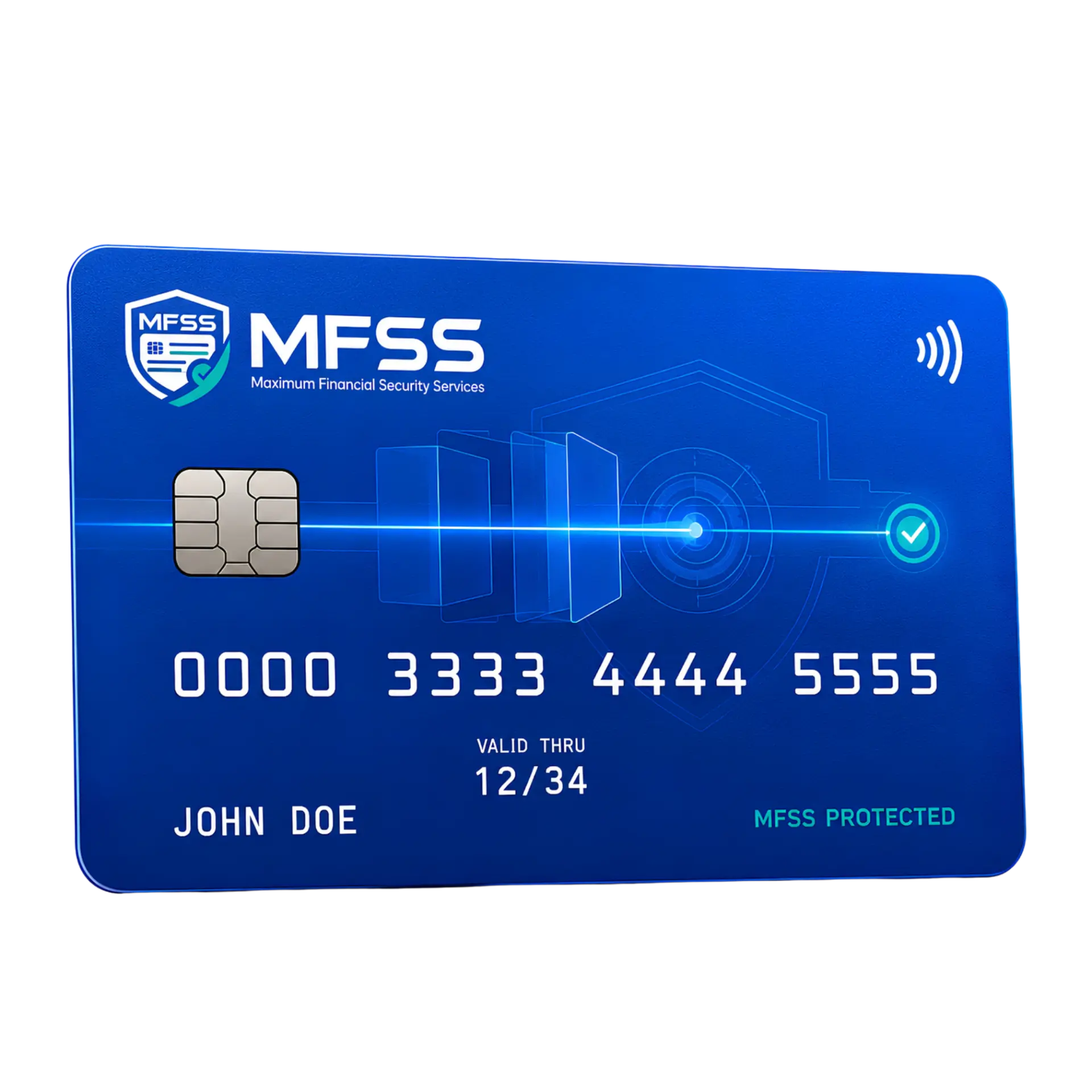
The MFSS concept is being developed around a stronger protective boundary between the point of sale and a consumer’s credit or debit card, while preserving normal access to their own finances.
The location or environment where a card transaction begins.
The proposed MFSS service concept is built around placing an additional protective layer within the transaction journey.
Authorized activity continues through the intended protected path.
The client maintains full use and access to their own credit and debit card finances.
“A stronger protective boundary between everyday card use and unauthorized activity.”
The animation is a conceptual representation of the proposed MFSS service model. Final service operation, technical specifications, capabilities, and limitations remain under development.
People who regularly use credit cards and debit cards for shopping, bills, subscriptions, travel, and daily expenses.
Households interested in improving awareness and confidence around shared financial card use.
Consumers who frequently make remote, mobile, online, or card-not-present payments.
MFSS is intended for these consumer groups. The developing service is being created with these cardholders in mind and does not represent current customer relationships.
Explain security concepts in direct, understandable language.
Avoid exaggerated claims, guarantees, or fear-based messaging.
Build the experience around the people who use financial cards every day.
Maintain a specialized focus on credit and debit card security.
The company's central focus is protecting credit and debit card use from unlawful or unauthorized activity.
Technical specifications, eligibility requirements, pricing, guarantees, and final service terms remain under development.
Additional details will be published as the business and proposed service model are finalized.
Submit an inquiry and a representative will follow up as additional business information becomes available. Submitting this form does not enroll you in a service.
Prefer a dedicated page? Visit the Contact page.